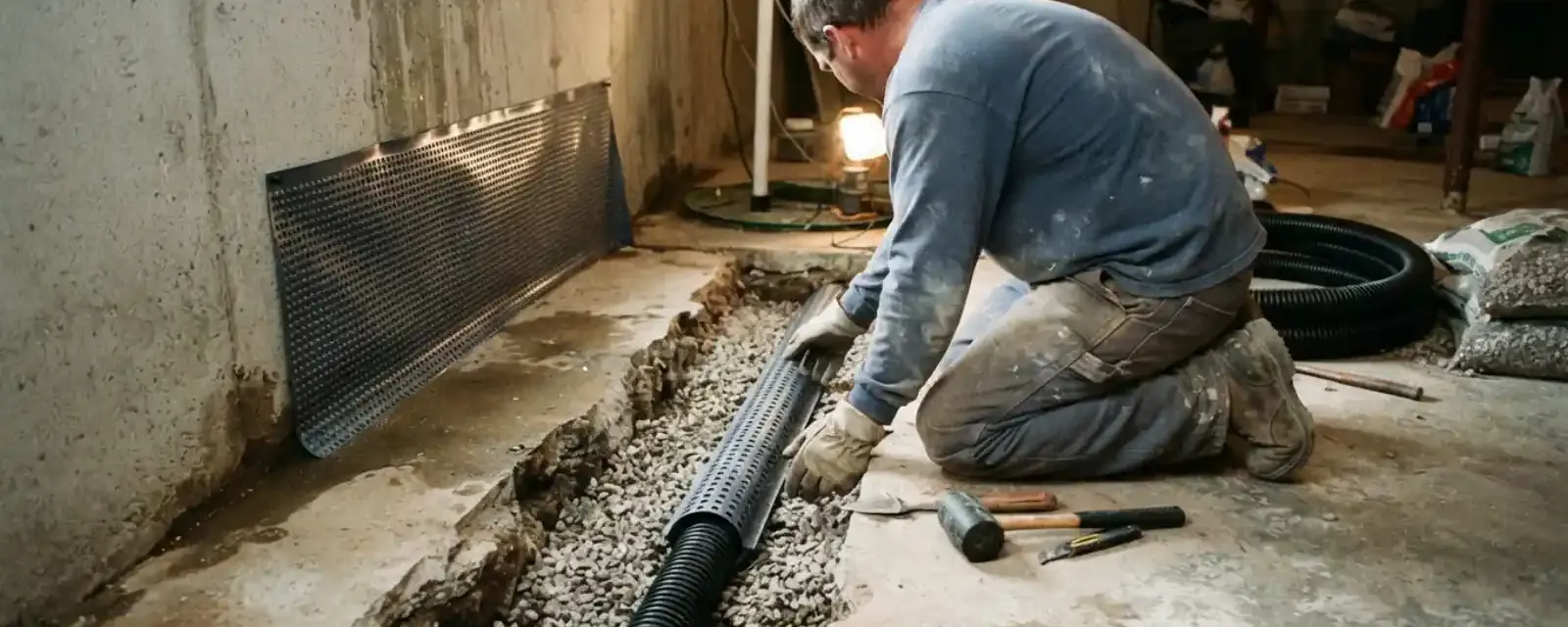
Waterproof paint for a basement is a thick masonry coating that blocks light moisture from passing through a concrete or block wall. In an Eden Prairie, MN basement it can calm a damp, chalky wall, but it is a coating, not a cure. If water is being pushed through the wall by wet soil, or leaking from a pipe, the paint will blister and peel within a season.
What the coating can do and what it cannot
A masonry waterproofing paint is a cement-based or acrylic layer, much thicker than wall paint. It fills pinholes and tiny voids in bare concrete, and it forms a film that slows vapor moving through the wall. On a surface with slight dampness and no active flow, that can be enough.
It cannot hold back pressure. When the ground outside is saturated, water presses against the wall and finds the weak spots, including cracks, the floor-wall joint and tie holes. The coating then bubbles from behind like a blister and lifts off in sheets.
Treat the paint as a finish for a dry wall that has some humidity, not as a repair for a wet one.
Run a moisture test before you buy a gallon
The plastic sheet test tells you where the moisture comes from. Tape a square of clear plastic, about two feet on each side, tightly to a bare section of wall, sealing all four edges with duct tape. Leave it for two or three days.
If water droplets form on the outside face of the plastic, the room air is humid and the problem is condensation. If droplets or darkening appear on the wall side, moisture is moving through the wall from outside. Test a few spots, including a low one near the floor and one near the corner.
| What you see on the sheet | What it points to | What to try first |
|---|---|---|
| Beads on the room side | Indoor humidity and cold wall | Dehumidifier, vent fans, wall insulation |
| Beads or dark patch on the wall side | Moisture moving through masonry | Grading fix, gutters, then coating |
| Water at the floor-wall joint | Groundwater pressure | Drainage solution, not paint |
| Wet wall near a pipe | Possible plumbing leak | Leak check before anything else |
Rule out a plumbing leak first
A supply pipe pinhole or a leaking drain joint will wet a wall as surely as groundwater, and paint covers the evidence without touching the cause. Look at the walls near the water heater, the laundry hookups and any pipe that crosses the basement. If a stain grows after you run the washer, that is a clue.
The City of Eden Prairie describes a simple overnight meter check. Record the meter reading at bedtime, use no water overnight with irrigation and water-using appliances off, and read the meter again in the morning. A changed reading means water is going somewhere. Our leak detection work uses the same logic, then adds acoustic and moisture tools to find the exact spot behind a wall.
If the reading holds still and the wall is still wet, the water is coming from outside, and you can focus on the surface itself.
Prepping the wall so the coating bonds
Paint fails more often from poor prep than from a poor product. Strip any old paint, scrub off dirt and cobwebs, and wire brush the whole surface. Waterproof coatings need a bare, clean, porous face to grip, so a glossy painted wall is a bad base.
Chip away loose mortar and patch cracks with hydraulic cement, which sets even against damp masonry. Fill the floor-wall joint only if it is dry and not leaking. Dampen the wall lightly with a spray bottle just before painting, because most masonry coatings cure better on a slightly moist surface.
Apply the first coat with a stiff brush, working it into pores, then add a second coat at a right angle to the first once the first has set. Follow the label for cure time, since most manufacturers want a day or more before you put a stored item against the wall.
Rather have a plumber look at it?
Our 24/7 line is open now, and same-day appointments are available when a slot is open.
Efflorescence: the white powder you cannot paint over
White, chalky crystals on a basement wall are efflorescence. Water carries salts out of the masonry and leaves them behind as it evaporates. The crystals tell you moisture is moving through the wall, even if the surface feels dry.
Brush the powder off with a stiff brush and wash it with a mild acid solution made for masonry, then rinse well and let the wall dry before you coat it. Paint over efflorescence and the salts push the film off from behind, which is why a patchy white bloom comes back under fresh paint.
If the powder returns after you clean it, the wall is taking on water. That is the point where basement waterproofing work, such as an interior drain with a sump, becomes the real conversation.
When paint fails and a different fix is needed
Peeling paint is the visible sign of hydrostatic pressure, which is water in the soil pushing against the foundation. Look for these patterns before you recoat.
Signs the wall needs more than paint
Blisters that refill
Bubbles that return after you pop and dry them mean water is pushing from outside.
Damp line at the floor
A wet band along the base of the wall is a common sign of groundwater at the footing.
Water after rain
A wall that is dry in August and wet in April has a drainage problem, not a surface problem.
Rust at the base of a post
Metal posts or the water heater feet showing rust points to repeated moisture.
For a wall that leaks, the useful options are exterior grading and gutters, an interior perimeter drain with a sump pump, or crack injection on a single structural crack. A coating can finish the job later, but it cannot lead it.
Reading the meter if you suspect a leak
The City of Eden Prairie says water meters are inside the home, usually in the basement near the water heater. That is the same corner where many basement leaks start, because the supply pipe and the heater connections all meet there. Check the meter dial and look for movement when every tap is off.
If the dial spins, shut off the main valve and see if it stops. That separates a leak in the house from a leak ahead of the shutoff. If it keeps moving, call (952) 866-9120 and we can help track it down. We also work in Bloomington and Hopkins, so wet-wall questions from nearby basements come to the same line.
Eden Prairie local note: your meter is your leak detector
The City says Eden Prairie water meters are inside the home, usually in the basement near the water heater, and not outside. That means the dial you need for a leak check is probably within a few steps of the wall you are worried about.
The City's overnight method is to record the reading at bedtime, use no water overnight and read it in the morning. If the reading has changed, a plumbing leak is on the table and the paint can wait.
Choosing between paint and a bigger repair
If the sheet test is dry, the meter check is steady and the wall only feels damp in humid weeks, a masonry coating is a reasonable weekend project. Add a dehumidifier to keep the room air dry. If the wall weeps after storms, put the money toward drainage first.
Ask for a written scope from any contractor. It should name the cause they found, the area covered and how the work reaches the water source, not just the surface.
Paint treats a surface only, while drains and sumps that move water away fall under the standards of the Minnesota Plumbing Code, Minnesota Rules chapter 4714.
Eden Prairie homeowner questions
No. It slows light moisture, but standing or pushing water gets behind it and lifts the coating. A leaking wall needs a drainage fix.
Rarely. Most masonry coatings need bare, clean concrete or block, so old paint should be stripped first.
It depends on the wall. On a dry wall with mild humidity it can last for years, while on a wall under water pressure it may fail in a single season.
It is efflorescence, left behind when water dissolves salts in the masonry and evaporates. It means moisture is moving through the wall.
Use the City's overnight meter check. Record the meter at bedtime, use no water overnight, then read it in the morning, and a changed number means a leak somewhere.
A floor coating has the same limits. If water rises through the slab or at the joint, it will lift the coating.