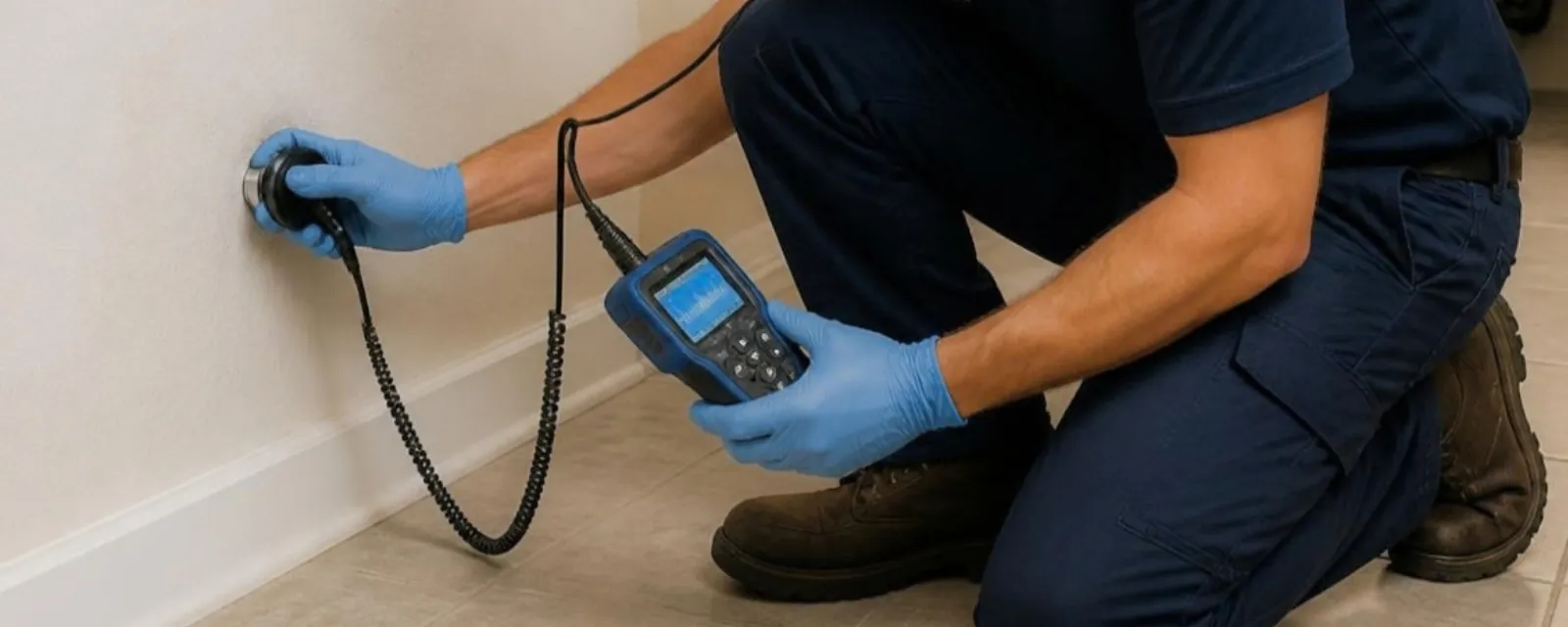
A hidden leak in Eden Prairie becomes an emergency the moment water shows on a ceiling, a floor turns warm or the meter keeps moving with every tap closed. Our 24/7 dispatch line sends licensed plumbers who do leak detection with listening gear, thermal cameras and pressure tests instead of opening walls at random. While you wait, shut off the main valve, switch off power to any wet area and keep people away from soaked outlets.
When a hidden leak is an emergency
Call right away if water is coming through a ceiling, running inside a wall, pooling around the water heater or rising through the basement slab. A floor hot enough to feel with bare feet counts too, because it points to a pressurized hot line under the concrete. Dispatch runs at night, on weekends and on holidays.
A creeping meter, a stain that is not growing or a bill that jumped last month can usually be handled with a same-day appointment when available. If you are unsure which group you are in, describe what you see when you call.
Start with the symptom you can see
Callers rarely ask for leak detection by name. They say the meter turns with everything off, the water bill jumped with no change in habits, a floor spot feels warm, a ceiling has a brown ring, the house smells musty or the shower has gone weak. Each clue has a short list of likely causes.
A ring that grows after someone showers upstairs points to a drain or supply joint above it, while a ring that grows on a dry day points to a pressurized line. A musty smell with no visible water often means a slow leak inside a wall or under a cabinet. Low pressure at every fixture at once suggests water is being lost before it reaches the house.
Signs of a hidden leak
The meter moves with everything off
Close every tap and appliance. Any movement on the dial means water is escaping.
A bill that jumps with no change in habits
If habits are unchanged and the bill still climbs, rule out a leak first.
Warm spots on the floor
A floor patch that stays warm can mean a hot line is leaking below.
A stain or bubbled paint on a ceiling or wall
Brown rings, soft drywall and peeling paint mean moisture sits behind the surface.
A musty smell or hidden mold growth
Dampness in a wall, vanity or crawlspace often smells before it shows.
Weak pressure everywhere
When every fixture runs weak at once, suspect a leak or a failing regulator.
Why hidden leaks turn up in Eden Prairie homes
The City says Eden Prairie grew from about 2,000 people in 1960 to almost 60,000 by 2000, so most homes date from the 1970s onward. That puts a large share of supply piping, water heater connections and fixture shutoffs at an age where valves and connectors begin to fail, often behind cabinets and inside finished walls.
Minnesota winters add stress. Pipes in exterior walls and unheated spaces contract and expand through below-zero stretches, and a joint that held for decades can start to weep. Older farm-era buildings may carry a mix of old pipe types.
The water meter and the high-bill leak
The meter is the best leak detector you own. The City says Eden Prairie meters are inside the home, usually in the basement near the water heater and sometimes in a crawl space or utility room. Its own overnight method is simple: record the reading at bedtime, use no water overnight with irrigation and water-using appliances off, read it again in the morning, and a changed reading means a leak.
The City says one person typically uses about 5,000 to 7,000 gallons per quarter and a family of three about 22,000. If your household sits well above that and nothing has changed, suspect a leak. The City offers a program called EyeOnWater for tracking use, and it investigates suspected meter problems at no charge, so ask the Utilities Division if you doubt the meter.
If the overnight test shows movement, we close valves one branch at a time while watching the meter. That usually tells us whether the leak is in the walls, under the slab or in the buried line.
Talk to a dispatcher about leak detection
Dispatch answers 24/7 and books same-day appointments when one is open.
Slab leaks: warm spots and the sound of running water
A slab leak is a pipe leak under the concrete floor, and it is urgent because the water has nowhere visible to go. Warm spots on the floor, the faint sound of water running when everything is off, new cracks in tile or baseboards, damp carpet near an exterior wall and a hot water bill that climbs are the usual clues. In a basement slab, water may also push up through a floor joint or crack.
We confirm a slab leak by isolating the lines with pressure tests, then pinpointing the spot with acoustic listening gear and a thermal imaging camera. Line tracing marks where the pipe runs so that any cut into the floor is as small as it can be. Repeat leaks may point toward repiping.
Leaks in ceilings and walls
Water on a ceiling is rarely coming from the spot where you see it. It can travel along a joist for several feet before dripping, so the stain shows the area to search, not the exact location. Common sources are a supply joint above, a leaking shower pan or tub drain, a failed toilet seal on the floor above and sweating from an uninsulated line.
We start with a moisture meter and thermal camera to map the wet area without cutting. Then we pressure test the suspect branch and listen along the pipe. The opening is usually one small access hole. If the culprit is a leaking base seal, toilet repair may be the whole fix.
Under the house and in the crawlspace
A damp patch on a joist, rust streaks on a pipe, a drip onto plastic sheeting or a musty smell on the first floor all send us underneath. Insulation soaked at one spot and dry nearby is a strong clue.
Access is the advantage here. We can see a weeping joint, check hangers and test one branch at a time without cutting a finished surface. Failed solder joints and corroded fittings are common finds. If the crawlspace has standing water, we also check whether the source is plumbing or groundwater, which can lead to sump pump repair instead.
Underground and buried line leaks
The City says property owners maintain all piping on their property, including the underground water service to the property line. A leak in the buried line is yours to find and fix. Signs include a meter that runs with everything off, a soggy yard patch in dry weather, an unusually green strip of lawn, a sudden pressure drop and the sound of water where the line enters the foundation.
We isolate the service line, listen along its route with ground microphones, trace the pipe and use a camera or tracer gas where the pipe allows. Call 811 (Gopher State One Call) before any digging so the other underground utilities are marked. Once the leak is located, our water line repair page covers repair, replacement and trenchless choices.
How we find a leak without tearing things open
No single tool finds every leak, so we match the method to the symptom. A pressure test shows whether a line holds. Acoustic listening picks up the hiss of pressurized water through a pipe or slab. Thermal imaging shows a hot line or a wet patch behind a surface, and moisture meters measure dampness in drywall, wood and concrete.
For stubborn cases, tracer gas is pushed into an isolated line and sniffed where it escapes. A camera inspects drain lines, and line tracing maps a pipe's path so the cut lands in the right place.
| What you see | Likely cause | Usual first step |
|---|---|---|
| Meter moves with all fixtures off | Leak in a supply line, slab or buried service | Overnight meter test, then isolate branches |
| Warm floor spot or sound of running water | Hot water line leaking under the slab | Pressure test, thermal scan, acoustic pinpoint |
| Growing brown ring on ceiling | Supply joint, drain, tub or toilet seal above | Moisture map, then test the suspect branch |
| Soggy yard patch in dry weather | Leak in the buried service line | Isolate the line, ground microphone, trace |
| Musty smell with no visible water | Slow leak in a wall, vanity or crawlspace | Moisture meter and camera check |
Sprinklers, pools, the curb stop and commercial sites
A broken head, a cracked lateral or a failed valve in a sprinkler zone can waste water for weeks before the lawn shows it. The City says rebates may be available for repairing irrigation, faucet or toilet leaks, so check its Water Conservation Rebate Programs page for current terms before you pay for a repair.
Evaporation can make a pool or spa look like it leaks, so we pressure test the plumbing lines to separate a pipe leak from a shell issue. At the street, the curb stop is the valve that lets the City shut off service to your home. The City will adjust it to ground level and replace the cap at no charge, so keep it uncovered.
Small commercial buildings get the same equipment, and commercial plumbing covers that work. Large facilities with complex piping may need a specialty survey, and we will say so plainly.
What happens after the leak is found
Finding the leak is half the job. We explain what failed and which options exist, from replacing a valve to rerouting a line. A pipe that has failed outright is covered under burst pipe repair, and worn connectors may call for new fixtures and shutoffs on that branch.
If water has already soaked drywall or carpet, photograph the damage before anything is removed.
What drives the cost of leak detection
The price depends on how hard the leak is to reach and how many tests it takes to pinpoint it. We give you a clear price before work starts.
Many homeowner policies cover sudden or accidental discharge but usually not gradual leaks or wear, and some cover the cost of reaching the pipe even when they will not cover the pipe itself. Ask your insurer before work starts, and keep photos and the written findings. Want your real number for your house? Call (952) 866-9120 and we will quote the job before work starts.
We serve Eden Prairie homes in the 55344, 55346 and 55347 ZIP codes with leak detection, and we also reach nearby Minnetonka and Hopkins addresses.
Finding a leak is diagnostic work, but the repair that follows is done to the standards of the Minnesota Plumbing Code, Minnesota Rules chapter 4714.
Leak Detection questions in Eden Prairie
Yes. Our dispatch line runs 24/7, including nights, weekends and holidays, and the plumber who comes can locate and stop an active leak. Shut off the main valve and keep people away from wet electrical areas while you wait.
Close every tap and turn off the irrigation system and water-using appliances, then read the meter at bedtime and again in the morning. The City says a changed reading means a leak. The meter is usually in the basement near the water heater.
Usually yes. We isolate the line with a pressure test, then pinpoint it with acoustic listening and thermal imaging. We only open the floor at the spot where the leak is confirmed.
A running toilet, a dripping supply line, an irrigation leak or a buried line leak can raise a bill without visible damage. Run the overnight meter test first.
The City says property owners maintain all piping on their property, including the underground water service to the property line. If the leak is on the street side of that line, ask the Utilities Division.
Yes. The City says it investigates suspected meter problems at no charge. Run the overnight test first so you can tell the City whether the reading changes when nothing is using water.
What to have ready when you call
Know where your main shutoff is and whether it is closed. Note what the meter reads. Write down when you first noticed the symptom, which rooms are affected and whether the water is hot or cold. Photograph stains before touching them, and keep the latest water bill nearby.