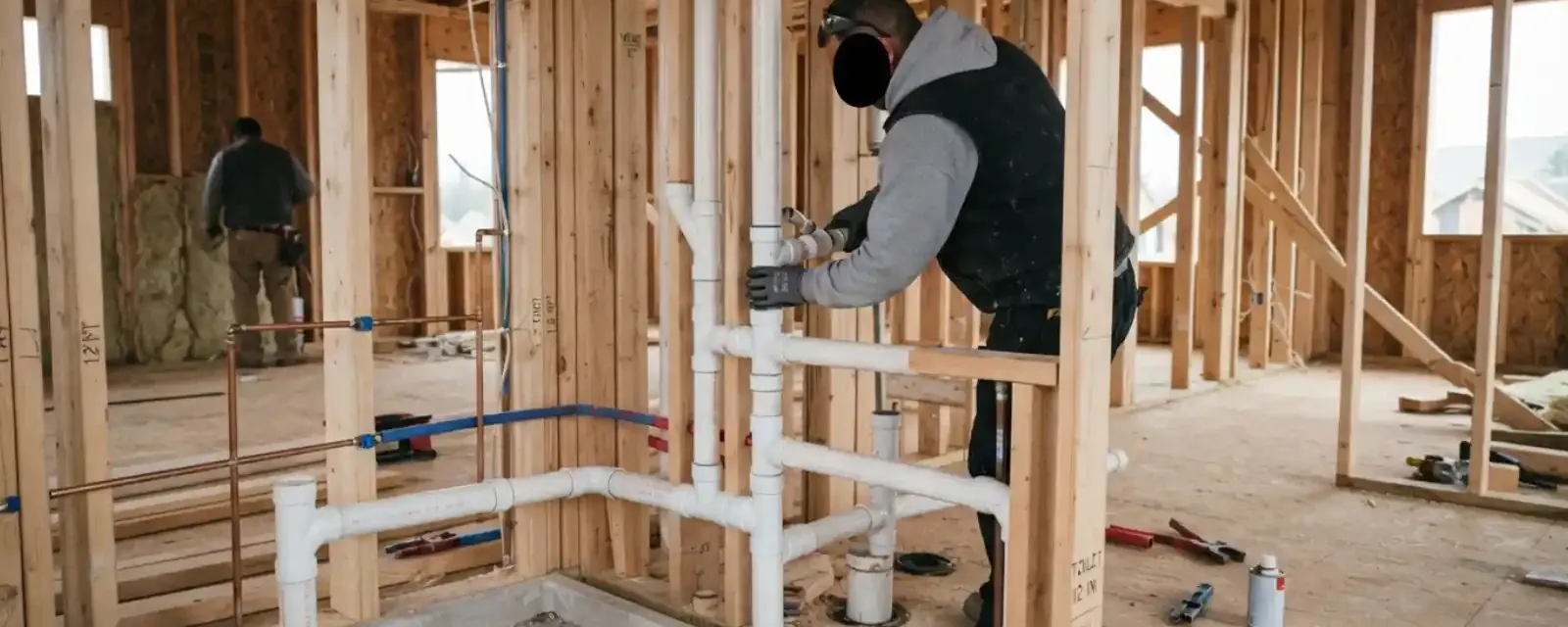
Plumbing installation in Eden Prairie usually starts with a floor plan and a list of fixtures, not a leak. Whatever the project, the order of work matters: drains and vents first, supply lines next, inspections in between, and fixtures last. Our 24/7 dispatch line also takes urgent calls, but this page is about planned work.
Good installation is mostly planning. Where the drain runs, how far the vent must travel and where the shutoffs go decide whether the finished room works or annoys you for years.
Where the work usually starts
Most installations fall into a few groups. A kitchen update moves the sink or adds a dishwasher, and a bath remodel swaps a tub for a shower. A finished basement adds a bathroom or wet bar, and a laundry room gets a new box and drain. Each needs its own trap, vent path and shutoff valves.
| Project | What gets installed | What to ask first |
|---|---|---|
| Kitchen remodel | Sink drain, vent, dishwasher tie-in | Does the sink move? |
| Bathroom remodel | Shower valve, vanity, toilet drain | Is the floor open? |
| Basement bath | Ejector basin, vent, new fixtures | Is the drain below the sewer line? |
| Laundry box | Washer valves and standpipe | Where is the nearest vent? |
| Softener or filter loop | Bypass and shutoffs on the main | Where is the main entry? |
Signs a patch will not be enough
Walls open already
If framing is exposed, adding or moving lines costs less now than after drywall.
Fixtures moving
Relocating a sink or toilet changes the drain slope and vent path, not just the visible parts.
Old shutoffs that fail
Stop valves that will not close mean new valves belong in the plan.
A basement with no drain
Waste has to be lifted with an ejector pump before any finished bath is possible.
Supply lines and PEX
Cross-linked polyethylene, or PEX, is the common choice for new residential supply lines today. It bends around corners, resists freezing damage better than rigid copper, and uses fewer fittings. A home-run layout runs a separate line from a central manifold to each fixture, so shutting off one sink does not cut water to the shower.
PEX still needs protection. It must be supported at proper intervals, kept away from direct sun, and routed with enough room for expansion. We also cover repiping for older homes where original supply pipes are being replaced instead of added to.
Drain, waste and vent basics
A drain works because air can enter behind the water. Each fixture drains through a trap, which holds a plug of water that blocks sewer gas, and each trap connects to a vent that lets air in so the water does not siphon out. Slope matters too: too flat and solids settle, too steep and water outruns the solids.
Toilets need larger drain pipe and a closer vent, and the floor often has to be opened to run it. The Minnesota Plumbing Code, Minnesota Rules chapter 4714, governs this work, and your plumber and inspector read it together.
Basement bathrooms and ejector pumps
Basement fixtures often sit below the city sewer line, so waste cannot drain by gravity. A sewage ejector pump collects waste in a sealed basin and lifts it up to the house drain. Choose a pump sized to the fixtures, and plan the basin, the vent and the access cover before concrete is cut.
If the basement also has a sump pit, keep the two separate. Our sump pump repair page explains why groundwater and sewage never share a basin.
Talk to a dispatcher about plumbing installation
Dispatch answers 24/7 and books same-day appointments when one is open.
Permits and inspections
Eden Prairie permits and inspections
Eden Prairie's Building Inspections Division issues the City's Sewer and Water Permit. The form covers sewer, water, commercial storm, inside water meters and repair-only work. Required inspections listed on that form are the rough-in visual, the final, the meter and the air test.
A permit becomes void if the authorized work is not started within 180 days, so schedule your plumber before you pay. Whether a particular job needs a permit varies, so ask the Eden Prairie building department before you open a wall.
Hiring a licensed contractor
Minnesota's Department of Labor and Industry says a plumbing contractor must always have a licensed master plumber as its responsible individual and must maintain a bond and insurance. Employees without a license work under direct supervision. You can check any plumber with the Department's license and registration lookup, which searches by the full license ID, so ask for that ID in writing before you hire.
State law lets a person without a plumber's license do plumbing work that meets the Plumbing Board's minimum standards on a home they own and live in. A local ordinance can forbid it, so ask the City first. Even where it is allowed, mistakes are expensive to open up and redo.
Gas smell safety comes first
If you smell gas, leave the building first. Do not flip switches, use a phone or light a flame inside. From outside, call the gas utility or 911, and only then call a plumber. We never promise a response time for gas calls.
Gas piping work is a separate matter from water and drain work. Who may install or inspect gas lines and what permits apply varies, so ask when you call. If you are planning a gas line for a range, dryer or water heater, we can tell you what we can do ourselves and what needs another licensed trade.
What installation costs
Homeowner insurance usually covers sudden damage but not poor workmanship or planned upgrades, so check with your insurer before a major remodel. Want your real number for your house? Call (952) 866-9120 and we will quote the job before work starts.
Our crews handle installation across Eden Prairie ZIP codes 55344, 55346 and 55347, and in nearby Chanhassen.
Related fixture and equipment installs
A remodel is the natural time to size a new tank or tankless unit, so see water heater installation. A swapped toilet is covered under toilet repair, a new kitchen tap under faucet repair, and a tired main under water line repair.
Installation questions
Plumbing Installation questions in Eden Prairie
It depends on the job. The City's Building Inspections Division issues a Sewer and Water Permit, so ask the Eden Prairie building department before work begins.
The City's permit form lists a rough-in visual inspection, a final, a meter inspection and an air test. Your plumber schedules them as the work reaches each stage.
Yes, it is widely used for supply lines. It bends easily, needs fewer fittings and tolerates cold better than rigid pipe, but it must be supported and protected from sun.
Usually, yes, if there is a drain path. If the fixtures sit below the sewer line, a sewage ejector pump and basin lift the waste up to the main drain.
Use the Minnesota Department of Labor and Industry license and registration lookup. It searches by the full license ID, so ask the contractor to provide theirs.
Leave the building at once, and call the gas utility or 911 from outside. Do not use switches, phones or flames indoors.
What to have ready when you call
Bring a rough sketch of the room, the list of fixtures and the location of the existing water main, drain and water heater. Tell us whether walls are open or finished, and whether you have already talked to the building department. Photos of the basement floor and the meter area help us plan the visit.