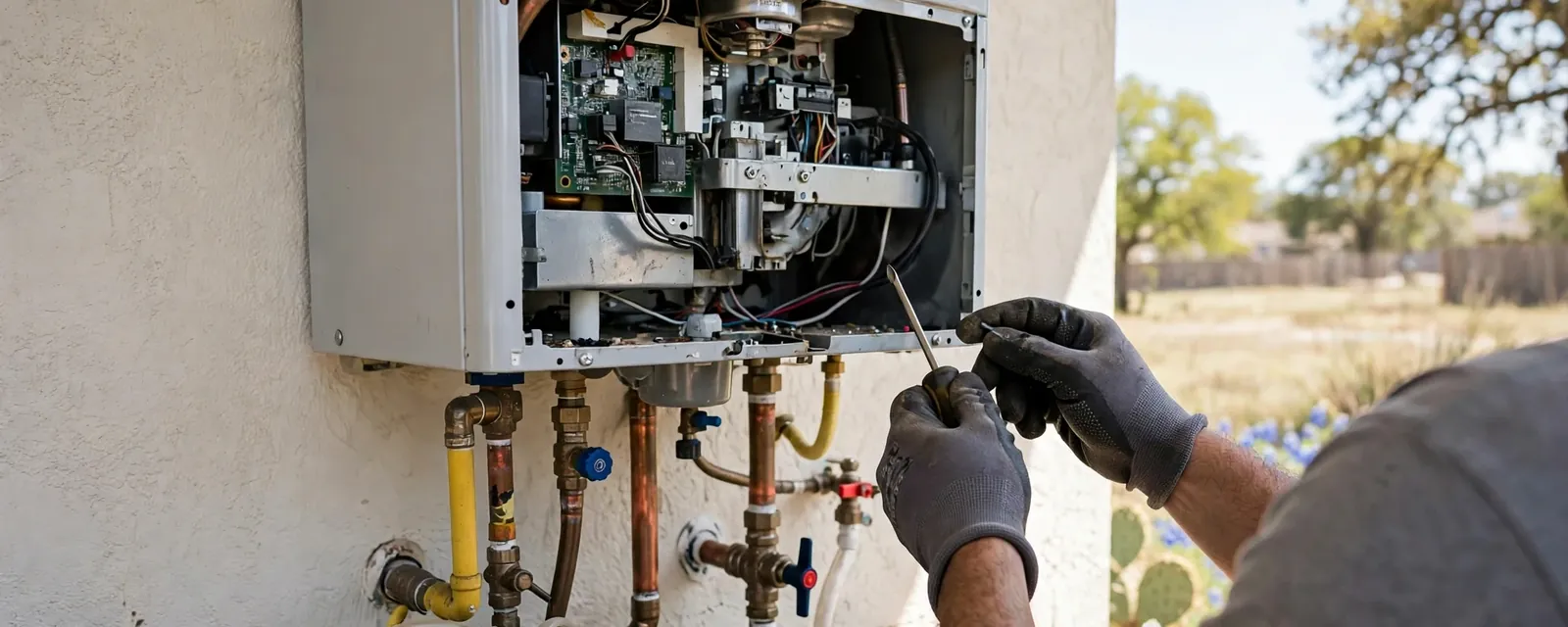
A tankless water heater heats water only when a tap opens, so it never runs out the way a tank can, and tankless water heater work in Eden Prairie comes down to sizing for a Minnesota winter. The details that decide success are flow rate, temperature rise, gas supply, venting and upkeep.
This page covers installing and repairing these units, a dedicated section on flushing, and a comparison with a storage tank. For basic tank work, see water heater installation.
Sizing by flow rate and temperature rise
Two numbers drive the choice. Flow rate is how many gallons per minute you need when several fixtures run at once. Temperature rise is the gap between incoming cold water and the hot setting you want.
In January the water entering a Minnesota basement is much colder than in summer, so the unit has to add more heat to reach the same shower temperature. A heater that looks fine on a July spec sheet can underperform in February. We size to the coldest incoming water and the busiest hour, not an average day.
Gas line, venting and condensate
Tankless gas burners need a lot of fuel in a short time, so a gas line sized for a tank heater is often too small. A larger line or a separate run may be needed, along with a gas meter check.
Venting is usually sealed PVC or stainless, either through a wall or the roof, and condensing models drain acidic condensate that needs a neutralizer or a safe drain. Electric tankless units skip the vent but pull a very heavy load on the panel.
Flushing and descaling a tankless heater
Scale is the main enemy of the heat exchanger. Minerals bake onto narrow passages, restrict flow and raise the temperature of the metal, which eventually triggers error codes or damages parts.
The City softens tap water to about 5 grains per gallon, so scale builds slower here than in towns using unsoftened well water, but it is not zero. Flushing is a routine job. Isolation valves on the hot, cold and gas lines let a plumber close off the unit, attach a small pump and hoses, and circulate white vinegar or a manufacturer-approved descaler through the heat exchanger for the time the manual calls for.
Then the unit is rinsed, the inlet screen is cleaned and the valves are reopened. Follow the interval in your manufacturer's instructions, and adjust if your unit is on a circulation loop or you add a water softener. If your home has no isolation valves, adding them is a cheap upgrade.
Symptoms and what usually causes them
Complaints about tankless units often sound alike but come from different faults, so matching the symptom to its cause saves time.
- Lukewarm showers: undersized unit, scale, a partly closed gas valve or a failing sensor.
- Temperature swings: low flow, a dirty inlet screen, a crossed connection or the cold-water sandwich.
- Error codes: ignition, vent, flame, scale or flow faults, each listed in the manual.
- No hot water at low flow: the unit needs a minimum flow to fire, often about half a gallon per minute.
Symptoms worth a call
Cold sandwich
A burst of hot water, then cold, then hot again when you pause and resume use.
Rattling or kettle noise
Scale on the heat exchanger or a failing fan.
Repeated error code
The same code returning after reset means a real fault.
Sooty or yellow flame
Combustion trouble. Turn the unit off and call.
Talk to a dispatcher about tankless water heater
Dispatch answers 24/7 and books same-day appointments when one is open.
Repair and error codes
Common repairs include cleaning flame rods, replacing igniters, swapping flow sensors, clearing vent blockages and fixing condensate drain clogs. A water filter or inlet screen that is clogged looks like a failed heater.
Every brand reports faults differently, so we read the code, check the manual and then verify with a gas pressure test or a flow check. If an older unit has cracked a heat exchanger, water heater repair gives way to replacement.
Tank or tankless?
| Factor | Storage tank | Tankless |
|---|---|---|
| Hot water supply | Limited by tank volume | Continuous at set flow |
| Space | Needs floor area | Wall mount, compact |
| Winter performance | Steady | Depends on temperature rise |
| Upkeep | Flush, anode rod | Flush, inlet screen, vent check |
| Installation scope | Often a like-for-like swap | Gas line, vent and drain changes |
If a tank has just failed and the budget is tight, a like-for-like tank may be the practical choice, as covered in water heater replacement. Tankless suits households with high demand and room for the vent and gas run.
What to know about Eden Prairie homes
Most local homes date from the 1970s onward, and the meter and heater typically share the basement, so a wall-mounted unit near the meter works well. Basements also run cold, which lowers incoming water temperature and affects rise.
Before you commit, test your tap hardness and ask the City about its annual water quality report. If you are considering softening for the heater alone, read our water softener and filtration page first, since the City says residents do not need a home softener.
Cost factors
Homeowner policies rarely cover planned upgrades or slow wear, so ask your insurer how it treats sudden failure and resulting water damage. Want your real number for your house? Call (952) 866-9120 and we will quote the job before work starts.
Service area
We install and service tankless heaters in Eden Prairie ZIP codes 55344, 55346 and 55347, and in Chanhassen. For a bigger remodel, pair the project with plumbing installation.
Tankless questions
A tankless unit is installed following the manufacturer's instructions and the standards of the Minnesota Plumbing Code, Minnesota Rules chapter 4714.
Tankless Water Heater questions in Eden Prairie
Follow the manufacturer's interval, which depends on water quality and use. The City's tap water is softened to about 5 grains per gallon, so scale is slower, not absent.
Many manufacturers allow white vinegar circulated through isolation valves, while others specify their own descaler. Check the manual before using anything.
Yes, if it is sized for winter incoming water temperature. The colder the supply, the higher the rise the unit must deliver.
That is the cold-water sandwich. Cold water left in the pipe reaches you after a pause. A recirculation loop or buffer tank can reduce it.
Often. The burner draws more fuel at once, so we check the line size and meter capacity.
Yes. Very low flow can leave the heater idle, so a trickle may stay cold.
What to have ready when you call
Write down the brand, model number and any error code. Note how many fixtures run at once, the coldest water you have seen, and whether isolation valves exist.
Take a photo of the unit, the gas meter and the vent run.