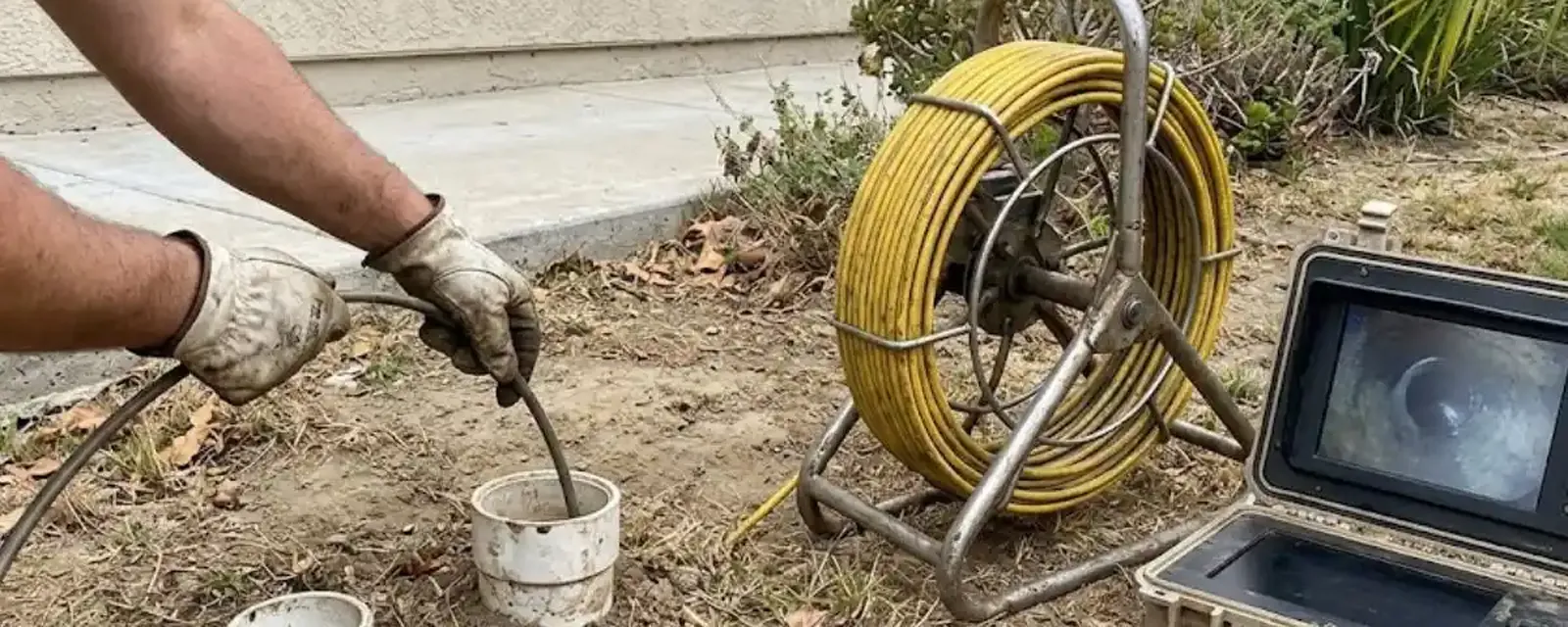
A sewer camera inspection in Eden Prairie, MN means feeding a waterproof camera head through a cleanout and down your building sewer while a plumber watches a live monitor. It shows roots, cracks, sags and offset joints without digging. Book one when buying a house, after repeat backups, or before anyone talks about lining the pipe. It cannot see through a full blockage, and it does not test for leaks.
How the camera gets into the pipe
The camera head is about the size of a thumb or a small can, ringed with bright LEDs and sealed against water. It rides on a flexible push cable wound on a reel, or on a small wheeled crawler for larger lines. A cable counter or a transmitter in the head tells the operator how far in the camera sits.
Most visits start at a cleanout, the capped fitting on the building sewer, often in a basement floor, a crawl space or just outside the foundation. If there is no cleanout, a plumber may pull a toilet to get in. That adds time, so mention it when you call.
Push camera or crawler: which one fits
A push camera suits the usual 3 or 4 inch residential line. The cable is stiff enough to shove the head around bends, and the unit is light enough to carry down basement stairs. For a long run to the street, a heavier crawler with its own wheels can keep the lens level and travel farther.
Neither type is better in general. The right one depends on pipe diameter, the number of turns, and how much debris sits in the line. A plumber will usually clear loose buildup first so the lens has something to look at.
What the footage can show
A clear run of clay, cast iron, PVC or ABS looks smooth, with joints appearing as a faint ring at regular spacing. Trouble stands out against that pattern.
- Fine root hairs entering at joints, or thick root masses filling the pipe
- Cracks, breaks or a collapsed section where the wall caves inward
- Offset joints where one pipe length has slipped off the next
- Scale, grease or debris narrowing the bore
- A belly, where the pipe sags and holds standing water
| What you see on screen | What it usually means | Typical next step |
|---|---|---|
| Hairlike roots at joints | A joint is open and drawing moisture | Clean the line, then plan repair |
| Water pooled along the floor of the pipe | A sag or belly in the grade | Locate it, then consider sewer line repair |
| Dark, flaking pipe wall | Aging cast iron with internal scale | Descale, then watch or replace |
| Pipe wall missing at the bottom | A break or collapse | Locate depth and plan excavation or lining |
Reading the footage like a homeowner
Ask for the recording and the depth reading, not just a verbal summary. A good report names the distance from the cleanout, the pipe material, and the type of defect at each spot. A sag at 20 feet and a root intrusion at 55 feet call for different fixes, and the distances let a repair crew find them again.
Pay attention to how bad the defect looks relative to how the line behaves. Light root hairs in a pipe that has never backed up can often wait and be monitored. A cracked section that already leaks soil into the line is a different conversation.
Rather have a plumber look at it?
Our 24/7 line is open now, and same-day appointments are available when a slot is open.
Three good times to book one
The first is before you close on a house. A camera look costs a small part of a sewer replacement, and it tells you whether the seller's line is sound. Older homes and homes with mature trees near the yard deserve the most scrutiny.
The second is after a repeat backup. If a drain clears and then clogs again in a few weeks, something in the pipe is catching debris. The third is before lining or any trenchless plan, because the installer needs to know the pipe's route, diameter and condition first. Our sewer inspection visits are built around those three cases.
What a camera cannot see
A camera sees only the inside surface of the pipe it can reach. It cannot see through water that fills the pipe, through a solid plug of roots, or past a collapse that blocks the head. In those cases a plumber clears the line first and then re-runs the camera.
It also does not prove a pipe is watertight. A hairline crack that only weeps during heavy rain may look like nothing on screen. And it says nothing about the water supply side: for pressurized lines, you want leak detection, not a sewer camera.
Preparing for the visit
A little prep saves time on site. Clear a path to the cleanout.
- Find your cleanout cap and note where it is.
- Stop running water and the dishwasher an hour before the visit, so the pipe is not flowing.
- Write down which drains have clogged, and when.
- Ask whether the recording will be sent to you afterward.
Eden Prairie local note: sewer lines of different ages
The City says Eden Prairie grew from about 2,000 residents in 1960 to almost 60,000 in 2000. That means the pipes under the city were laid across several decades, not in one batch. Two neighbors on the same street can have building sewers of different ages and materials, so a camera look at your own line tells you more than the street's reputation does.
The City's Utilities Division oversees 262 miles of public sanitary sewer main. Your building sewer is the private piece that connects your house to that main, and the footage helps you see which side a problem sits on. The City does not state who owns a home's sewer service line, so ask the Utilities Division before assuming the repair is yours or theirs.
When the footage points to repair
If the recording shows a break, a bad sag or heavy root damage, the options run from spot repair to full replacement. A short failure near the house may be a small dig. A long run of damaged clay may be better served by lining or pipe bursting, if the installer's camera work says the route allows it.
Our team handles sewer line repair after the footage is reviewed, with a clear price before work starts. Permit rules for sewer and water work vary, so ask the Eden Prairie building department whether your job needs one.
Service area and booking
The same 24/7 dispatch covers Eden Prairie, MN, and we also cover Hopkins and Minnetonka homes. If you have a sewage backup tonight, treat it as urgent: stop using water, keep people away from the wet area, and call (952) 866-9120. The camera visit can follow once the line is flowing again.
For nearby calls, see how we work in Hopkins and Minnetonka, where older housing stock often benefits from the same camera check. Same-day appointments are offered when available.
Any sewer repair found by a camera is done to the standards of the Minnesota Plumbing Code, Minnesota Rules chapter 4714.
Eden Prairie homeowner questions
A straightforward run from a cleanout often takes under an hour once the plumber is set up. Cleaning the line first, long runs, or hard access can stretch the visit. Ask for the recording so you can review it later.
A properly sized push camera is gentle on sound pipe. On a badly deteriorated line the head can snag, which is part of why the plumber reads the footage as it goes. Tell the plumber about any past collapse or repair.
Cheap consumer cameras exist, but they are short, hard to steer and offer no distance reading. They can show a clog near the cleanout. For a buying decision or a lining plan, a professional unit and a trained eye are worth it.
No. It tells you the pipe's condition on that day. Grease, wipes and new root growth can still cause a clog later, so keep up good habits and rerun the camera if problems return.
The City reports growth from about 2,000 residents in 1960 to almost 60,000 in 2000, so lines were laid in many different decades and materials. A newer subdivision can sit near an older farm-era building. Camera footage of your own line is the only reliable way to know which you have.