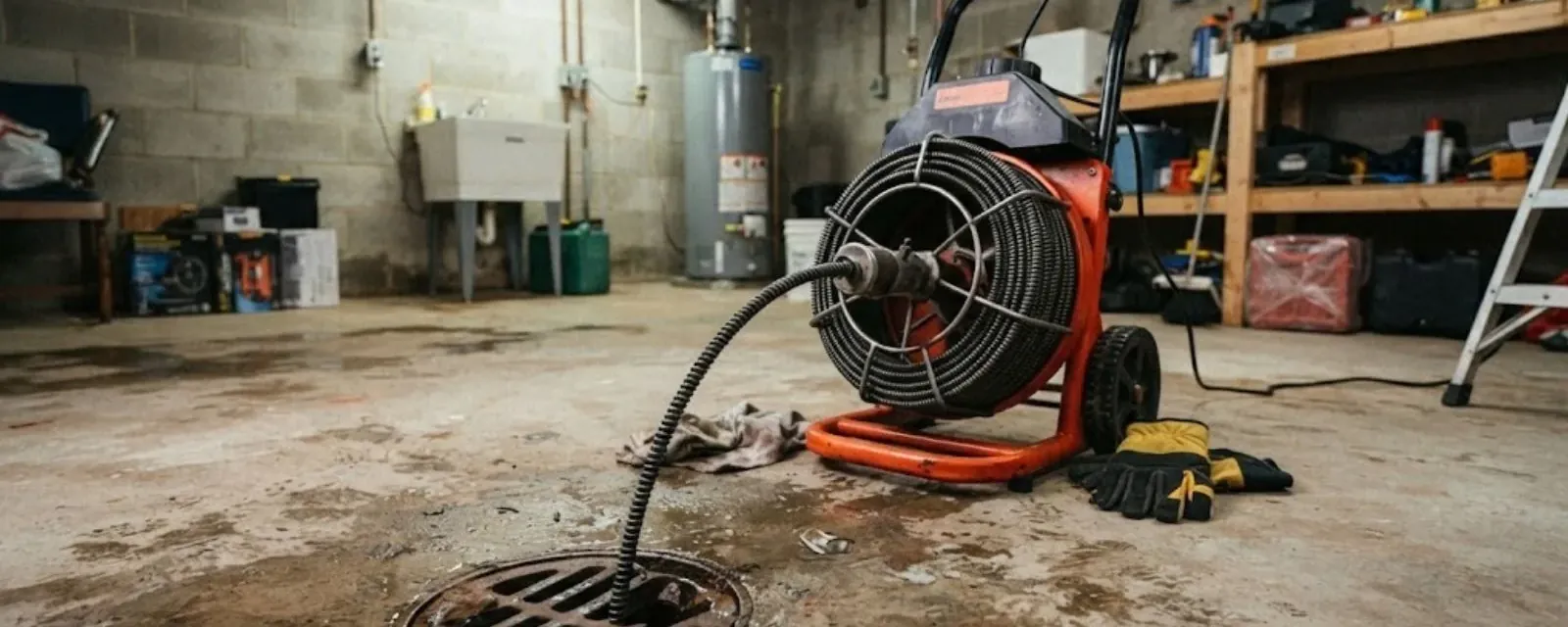
A plumbing snake for a kitchen sink works best as a hand auger of roughly 15 to 25 feet, fed through the trap or a cleanout and turned until it grabs the clog. In an Eden Prairie, MN kitchen, that clears most slow sinks when the blockage sits in the first few feet of pipe. If the cable runs free and the sink still backs up, the clog is farther along.
Hand auger or drum auger: which one belongs under your sink
A hand auger is a coiled steel cable inside a small drum with a crank handle. You feed the cable into the drain, tighten a set screw, and turn the crank so the tip bores into the clog. It costs little, fits under a cabinet, and suits a single kitchen branch.
A drum auger is the bigger cousin, with a long cable on a wheel and often a drill-style or electric drive. It reaches farther, which sounds better, but it is awkward in a crowded sink cabinet and easy to kink in the tight bends of a kitchen trap. Most households should reach for the hand auger first.
Skip the thin plastic strips with barbs sold in grocery aisles for anything greasy. They snag hair in a bathroom sink but slide through a kitchen clog made of congealed fat and coffee grounds without moving it. A real steel cable with a corkscrew or hook tip does the work.
What to set out before you start
Kitchen drains smell, splash and drip, so a little preparation saves a mess. Gather these before you open anything.
- A bucket and an old towel for the trap
- Rubber gloves and eye protection
- A flashlight and a small rag for wiping the cable
- Channel-lock pliers for slip nuts that are stuck
- A hand auger with a quarter-inch to three-eighths-inch cable
Clear the cabinet under the sink, run the disposal switch off at the wall if you have one, and stop using the dishwasher until the drain is open. A dishwasher that drains into a blocked sink will push dirty water back up into the basin.
Running the snake through the trap or cleanout
You can feed the cable down through the strainer opening, but the cleaner route is through the trap. Taking the trap apart lets you see what is in it and keeps the cable from bending hard through the curve.
- Empty the cabinet Move the cleaners aside and set the bucket directly under the U-shaped trap.
- Loosen the slip nuts Turn both nuts by hand or with pliers, then lower the trap into the bucket and check it for packed grease.
- Feed the cable Push the tip into the wall pipe a foot at a time, and tighten the set screw so the cable turns as one piece.
- Crank slowly Turn the handle clockwise and push gently, because a sudden jump means the tip has broken into the clog.
- Pull back and clean Draw the cable out hand over hand and wipe it as it comes so you do not smear waste onto the cabinet floor.
- Reassemble and flush Refit the trap with the washers seated flat, then run hot water for a full minute and look for drips.
Some kitchens have a cleanout fitting in the wall behind the sink or in the basement ceiling below it. A cleanout is a capped opening on the drain line, and opening it gives the cable a straighter path than the trap does. Put a bucket under it first, because standing water will pour out.
Reading what the cable tells you
The feel of the auger tells you a great deal about the blockage. A soft, gummy resistance usually means grease. A sharp stop followed by a scrape often means a hard item. A smooth run all the way in with no catch means the clog is not where you are working.
| What you feel | What it usually means | Your next move |
|---|---|---|
| Soft drag, then the water drops | Grease and food paste in the branch | Flush with hot water and wipe the cable |
| Hard stop that will not turn | A bend or a solid object | Back out a few inches and try again gently |
| Cable runs free, sink still slow | Clog lies farther down the line | Stop snaking and plan on a deeper clean |
| Water gurgles at other fixtures | Shared drain or main line trouble | Stop and call a plumber |
Rather have a plumber look at it?
Our 24/7 line is open now, and same-day appointments are available when a slot is open.
What a snake cannot fix
A kitchen snake punches a hole through a clog. It does not scrape the pipe wall clean. Years of cooking grease can leave a lining inside the pipe that narrows it, and the auger just drills a pinhole through the middle. The sink drains for a week, then slows again.
That pattern, a quick improvement followed by a fast relapse, points to a grease-lined pipe farther down. The permanent fix there is a high-pressure wash, which is what hydro-jetting does by scouring the full pipe wall instead of boring one channel through it.
A snake also cannot fix a main line problem. If the kitchen sink backs up along with a toilet, a shower or a basement floor drain, the blockage is probably past the branch you are working on. Forcing more cable into that situation wastes an afternoon and can push waste back toward the lowest fixture in the house.
Cracked, sagging or root-invaded pipe is another case. The auger can catch on a joint and tear a cable off inside the line, which turns a simple clog into a retrieval job.
When to put the snake away and call
Plenty of people succeed with a hand auger, and there is no shame in trying. Know your stopping points though.
Call when the full cable length brings no relief, when the clog returns within days, or when more than one fixture is affected. Water rising from a floor drain is another reason. Our crew handles drain cleaning day and night on a 24/7 line, so call (952) 866-9120 and we will explain the next step before work starts.
We also cover Minnetonka and Hopkins homes on the same line.
Keeping the drain open afterward
Habits matter more than any tool. Wipe greasy pans with a paper towel before rinsing, and put cooled fat in a can for the trash instead of the sink. Run hot water for 30 seconds after washing dishes so the day's oils move past the trap.
Scrape plates into the trash, not the drain. Coffee grounds, rice and pasta swell and pack into the trap.
Eden Prairie local note: who handles what
Eden Prairie's Utilities Division oversees the City's water, sanitary sewer and storm sewer systems. The City describes 262 miles of sanitary sewer main and 23 lift stations, so a clog inside your own kitchen is a house-side problem and the City's mains are far downstream of it.
The City does not say who owns or maintains a home's sewer service line, so if your backup seems to come from outside the house, ask the Utilities Division directly. For leaks or frozen pipes, the Utilities Division answers on weekdays from 7 a.m. to 3:30 p.m., and the City directs those reports to the Police Department after 3:30 p.m. and on weekends.
Eden Prairie homeowner questions
Yes, but unplug the disposal or shut off its switch first. Many people remove the trap arm past the disposal and feed the cable through that opening so the blades are never in the way.
Most kitchen clogs sit within the first six to eight feet from the trap. If you have fed in the full length of a standard hand auger and met nothing, stop and look for a deeper or shared line problem.
A snake bores a hole through the middle of a blockage but leaves the grease coating on the pipe wall. The pipe narrows again quickly, which is why a thorough wash such as hydro-jetting is the lasting answer.
It is better not to. Chemical cleaners sit in the trap, burn skin and eyes if they splash during snaking, and can leave you opening a trap full of caustic water.
A clog inside the house belongs to you and a licensed plumber. If the backup affects the whole home or looks like a city main problem, ask the Utilities Division on weekdays during business hours.
A careless one can. Forcing a stiff cable through a tight bend, or cranking hard against a hard stop, can scratch plastic or crack an old fitting, so go slowly and back out if it binds.